
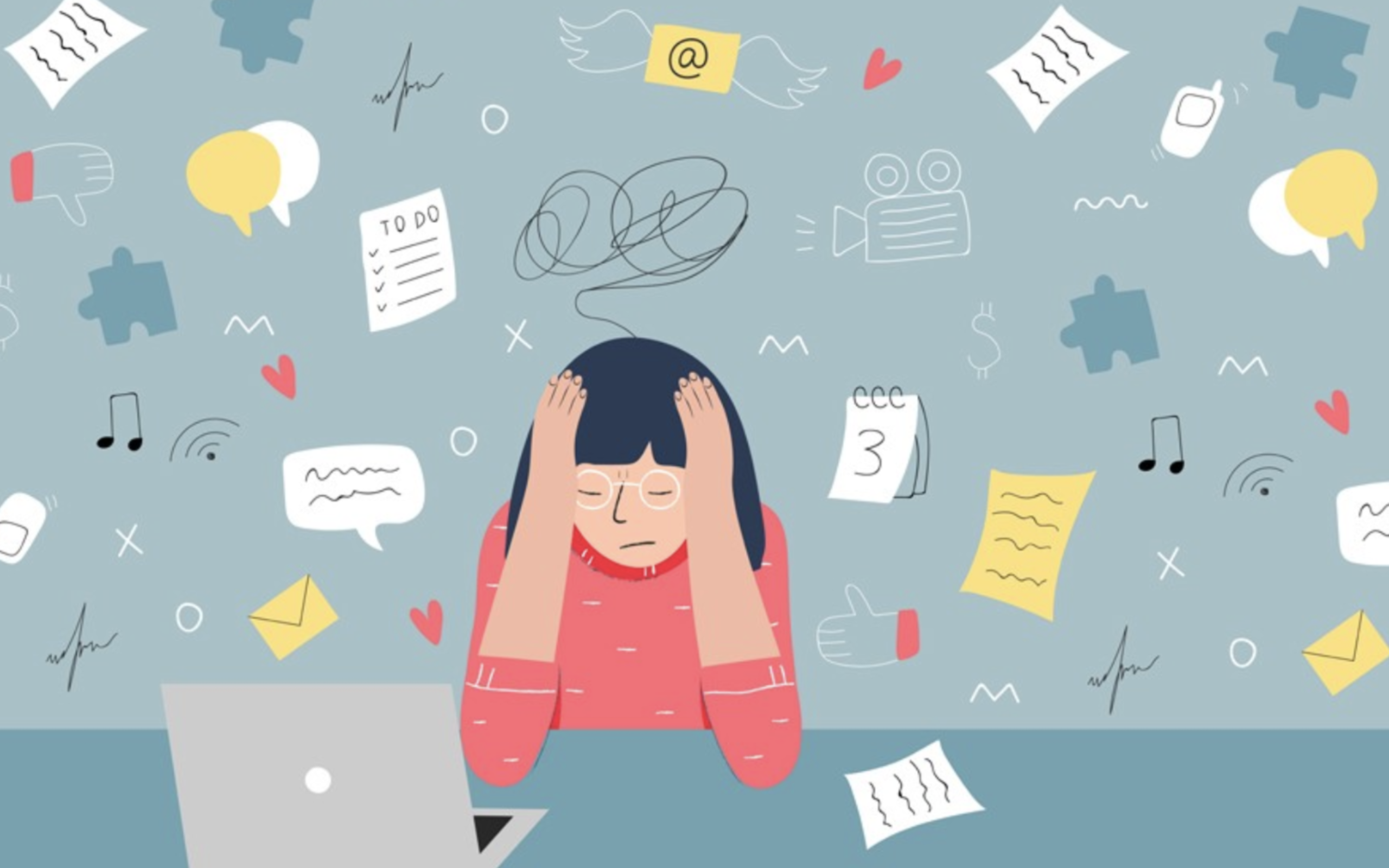
Introduction: Defining Stress, A Work in Progress
MedlinePlus Medical Encyclopedia (2022) defines stress as a feeling of emotional or physical tension.
Alright, so you know that feeling when everything just seems to pile up and you start feeling all tense and overwhelmed? That’s stress kicking in. It’s your body’s way of reacting to any kind of disturbance, whether it’s mental, emotional, or physical.
Stress is a complete body and mind issue; it is “the body’s response to any mental, emotional, or physical disturbance. It is now well accepted that stress is both a symptom and a major risk factor for anxiety, migraines, substance abuse, obesity, and heart disease” (Ramanathan & Desrouleaux, 2022).
In reality, stress helps you handle any challenges that come your way. But, when stress sticks around for too long or becomes too intense, it can start affecting your body and mind. We’re talking about chronic stress, the kind that feels like it’s always in your head. It can come from different places – relationship drama, money worries, you name it – and it can mess with your physical health, leaving you feeling tired, on edge, not really you.
Plus, stress isn’t just about what’s going on in your own life. It’s influenced by bigger stuff too, like what’s going on in the world around you.
So yes, stress can be complex, but by understanding all the different factors that come into play, we can start figuring out how to manage it better and keep ourselves feeling chill and happy, both as individuals and as a society! So let’s start with useful, important, and interesting facts about stress!
Part 1: The Different Layers of Stress
Stress isn’t just a mood; it’s like a whole experience for different parts of your body and mind. Let’s dive into how it works and what it does to us, so when stress appears, we can be able to identify it and actually do something about it. The best way to win any battle is by being informed.
How the Body Reacts to Stressors
Stress Hormones on Health
The Psychological Reaction
Part 2: Understanding Stress
To fully understand stress, we need to learn a bit about stress hormones! When we’re faced with challenges, our body segregates a bunch of hormones and neurotransmitters to help us deal. Calm comes when all these hormones and neurotransmitters are balanced.
Cortisol, the Stress Hormone
Epinephrine, or Adrenaline Rush
Gut-Brain Connection: Keep Your Tummy Happy!
Part 3: Good Stress, Bad Stress
You know, not all stress is bad news! In fact, there’s this whole spectrum of stress – from the good stuff to the not-so-great – and each type has its own impact on how we feel.
Eustress: the Bright Side of Stress
Distress: When Stress Takes a Dark Turn
The Tipping Point: Too Much Stress
Part 4: Tips for Stress Management
How we deal with stress can make all the difference in how we feel. So, let’s talk about some super helpful strategies for managing stress like a boss.
Mindfulness and Meditation
Benefits of Mindfulness and Meditation:
How to Practice Mindfulness and Meditation:
Exercise to Release Stress
When you get moving, your body releases these chemicals called endorphins. They’ll make you feel all kinds of good vibes. Plus, it’s a killer way to kick stress and boost your overall well-being.
Benefits of Exercise for Stress Relief:
Incorporating Exercise into Your Routine:
Connection. Disconnect to connect
When you’ve got a crew that’s got your back, you’ll always have someone there to lift you up when you’re feeling down, give you a high-five when things are going well, and lend a hand when you need it most.
So, whether it’s your family, friends, or even your cute pets, building and nurturing those relationships is essential for keeping your spirits high and your stress levels low.
Benefits of Social Support:
Ways to Cultivate Social Support:
Part 5: How Does Culture and Society Influence Stress?
To deal completely with stress, we’ve got to zoom out and look at the big picture. That means understanding how stress impacts not just us as individuals, but also our communities, our cultures, and our societies as a whole.
By taking a broader view, we can start to see the patterns and trends that shape our stress levels. Maybe it’s the pressure to succeed in a competitive school, the constant bombardment of information on social media, or the strain of societal expectations weighing us down. Whatever the case, getting a handle on these bigger-picture stressors is key to finding solutions that work for everyone.
Cultural Influences
The Role of Technology
Let’s talk about how the digital world can stress us out:
Compassion and Empathy
Now, let’s talk about why compassion and empathy are so important during stressful times:
Conclusion: Now We Know More About Stress
Stress can feel like it’s always there, testing our strength. But even in chaos, there are opportunities for growth. In this final chapter, I want to reflect on what we’ve learned and try to imagine a future where stress will help us by empowering us and giving us balance and compassion.
We explored the various dimensions of stress, from its physiological effects on the body to its societal and cultural influences. We’ve discovered strategies for managing stress, and we recognized that while stress can be overwhelming, it also holds the potential for personal growth, and gets us stronger.
So let’s hold onto the lessons we’ve learned and embrace the challenges that lie ahead with courage and compassion.
Finding Balance. Feeling in Control
In the journey through life’s ups and downs, finding balance is like striking gold. It’s not about avoiding stress altogether, but rather about managing it.
So, embrace the power of understanding, take control of your stress, and get ready to conquer whatever life throws your way. You’ve got this!
Bibliography
Khansari DN, Murgo AJ, Faith RE., (1990). Effects of stress on the immune system. Immunology Today. 11, 170–175.
Lecic-Tosevski D, Vukovic O, Stepanovic J. (2011). Stress and personality. Psychiatriki, 22(4):290-7. PMID: 22271841.
Matko K, Sedlmeier P. (2019) What Is Meditation? Proposing an Empirically Derived Classification System. Front Psychology, 10:2276.
Ramanathan R, Desrouleaux R. (2022) Introduction: The Science of Stress. Yale Journal of Biology and Medicina, 31;95(1):1–2. PMCID: PMC8961711.
Sukhareva EV. (2021) The role of the corticotropin-releasing hormone and its receptors in the regulation of stress response. Vavilovskii Zhurnal Genet Selektsii, 25(2):216-223. doi: 10.18699/VJ21.025. PMID: 34901719; PMCID: PMC8627883.
Yaribeygi H, Panahi Y, Sahraei H, Johnston TP, Sahebkar A. (2017) The impact of stress on body function: A review. EXCLI, 21;16:1057-1072. doi: 10.17179/excli2017-480. PMID: 28900385; PMCID: PMC5579396.
Calm Clinic. (2021). Biochemistry of anxiety. Retrieved from: https://www.calmclinic.com/anxiety/biochemistry-of-anxiety
Cleveland Clinic. (2021) Cortisol: What it is, function, symptoms & levels, Cleveland Clinic. Retrieved from: https://my.clevelandclinic.org/health/articles/22187-cortisol
Harvard Health. (2022). The gut brain connection. Retrieved from: https://www.health.harvard.edu/diseases-and-conditions/the-gut-brain-connection
Harvard Health. (2020). Understanding the stress response. Retrieved from: https://www.health.harvard.edu/staying-healthy/understanding-the-stress-response
Healthline. (2019) Eustress vs Distress. Retrieved from: https://www.healthline.com/health/eustress#eustress-vs-distress
MedlinePlus. (2022). Stress and your health: Medlineplus medical encyclopedia. Retrieved from: https://medlineplus.gov/ency/article/003211.htm
Psychology Today. (n.d.). Mindfulness. Retrieved from: https://www.psychologytoday.com/us/basics/mindfulness
Psychology Today. (n.d.). Which personality types are the best at dealing with stress. Retrieved from: https://www.psychologytoday.com/intl/blog/think-act-be/202310/which-personality-types-are-the-best-at-dealing-with-stress
Note: The Free Your Mind Mental Health Society is an independent youth-led organization. The contents of this blog are not intended to be a substitute for professional medical advice, diagnosis, or treatment. Always seek the advice of your physician or another qualified health provider with any questions you may have regarding a medical condition. In the event of a medical emergency, please call your doctor or 911 or other local emergency numbers immediately.




Leave A Comment